<?xml version="1.0" encoding="utf-8"?><feed xmlns="http://www.w3.org/2005/Atom" ><generator uri="https://jekyllrb.com/" version="3.10.0">Jekyll</generator><link href="https://www.soundandmovement.info/feed.xml" rel="self" type="application/atom+xml" /><link href="https://www.soundandmovement.info/" rel="alternate" type="text/html" /><updated>2026-11-19T23:27:06+00:00</updated><id>https://www.soundandmovement.info/feed.xml</id><title type="html">Sound and Movement</title><subtitle>Practice research in spatial audio, sonic movement and multimodal perception by Tommaso Perego.</subtitle><author><name>Tommaso Perego</name></author><entry><title type="html">Full choreography from random picks</title><link href="https://www.soundandmovement.info/blog/2024/08/full-choreography-from-random-picks/" rel="alternate" type="text/html" title="Full choreography from random picks" /><published>2024-08-02T00:00:00+01:00</published><updated>2024-08-02T00:00:00+01:00</updated><id>https://www.soundandmovement.info/blog/2024/08/full-choreography-from-random-picks</id><content type="html" xml:base="https://www.soundandmovement.info/blog/2024/08/full-choreography-from-random-picks/"><![CDATA[<p>One of the first problems in building the work was designing a choreography that could be played and experienced through randomly selected snapshots.</p>

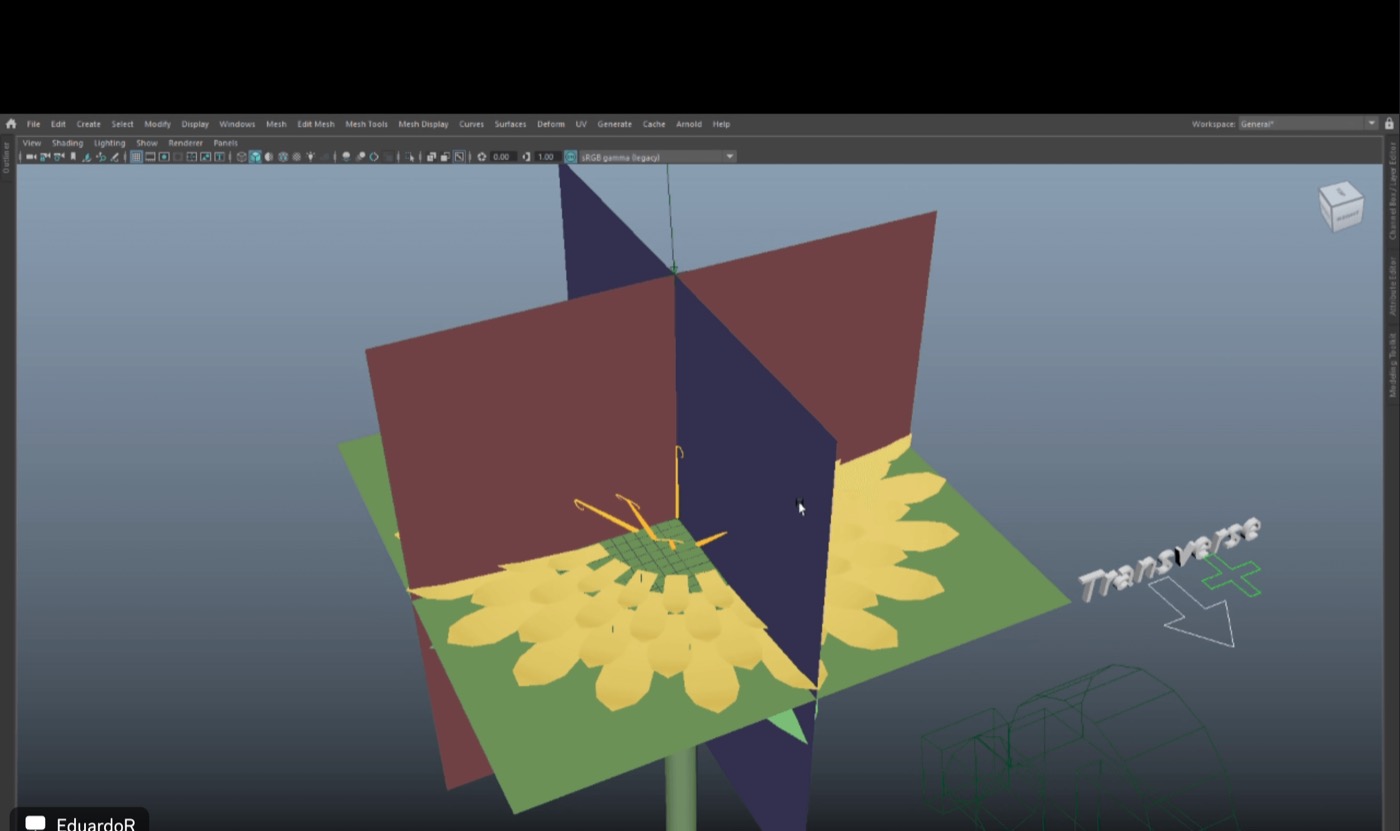
<p>Noora characterised the pollen through movement ideas developed in rehearsal with dancers, tracing their paths and behaviours. With Eduardo she then translated these into trajectories in Maya, starting from each flower and fitting the shape, size, angle and movement of its petals and stamens.</p>

<p>This led to three distinct types of pollen per flower. To add variety, each trajectory is rotated around the flower’s centre: the same path repeated in 10 instances over 360° of azimuth, which produced the origami-like patterns in <a href="/blog/2024/08/randomness-colour-and-the-poppy/">the poppy post</a>.</p>

<p>When the bee hits a flower, 1–10 pollen are released from types A, B or C, at any of the 10 angles on the horizontal plane. The combinations in space are unpredictable, which gives great variety but raises questions about the choreographic relationship between paths:</p>

<ul>
  <li>What of the movement is understandable?</li>
  <li>How much of the characterisation survives?</li>
  <li>Were the individual paths ever meant to play together, or only individually?</li>
</ul>

<p>I will follow this up with Noora at the end of the work.</p>]]></content><author><name>Tommaso Perego</name></author><category term="Song of the Bees" /><summary type="html"><![CDATA[One of the first problems in building the work was designing a choreography that could be played and experienced through randomly selected snapshots.]]></summary></entry><entry><title type="html">Randomness, colour and the poppy</title><link href="https://www.soundandmovement.info/blog/2024/08/randomness-colour-and-the-poppy/" rel="alternate" type="text/html" title="Randomness, colour and the poppy" /><published>2024-08-01T00:00:00+01:00</published><updated>2024-08-01T00:00:00+01:00</updated><id>https://www.soundandmovement.info/blog/2024/08/randomness-colour-and-the-poppy</id><content type="html" xml:base="https://www.soundandmovement.info/blog/2024/08/randomness-colour-and-the-poppy/"><![CDATA[<p>Discussion with Kush and Eduardo, then a meeting with Eduardo and Noora.</p>

<p>We discussed randomness in relation to the total number of pollen and the whole choreographic pattern. Pollen types and rotations are now chosen at random, but could be guided by Noora’s decisions (for example, maximum rotation limits per type). We also discussed colour per type and colour gradients, which carry weight in the audiovisual result.</p>

<p><img src="/img/bees/02.jpg" alt="Colour study of pollen trajectories" /></p>

<p><img src="/img/bees/03.jpg" alt="Colour study of pollen trajectories" /></p>

<p><img src="/img/bees/04.jpg" alt="Colour study of pollen trajectories" /></p>

<h2 id="the-poppy">The poppy</h2>

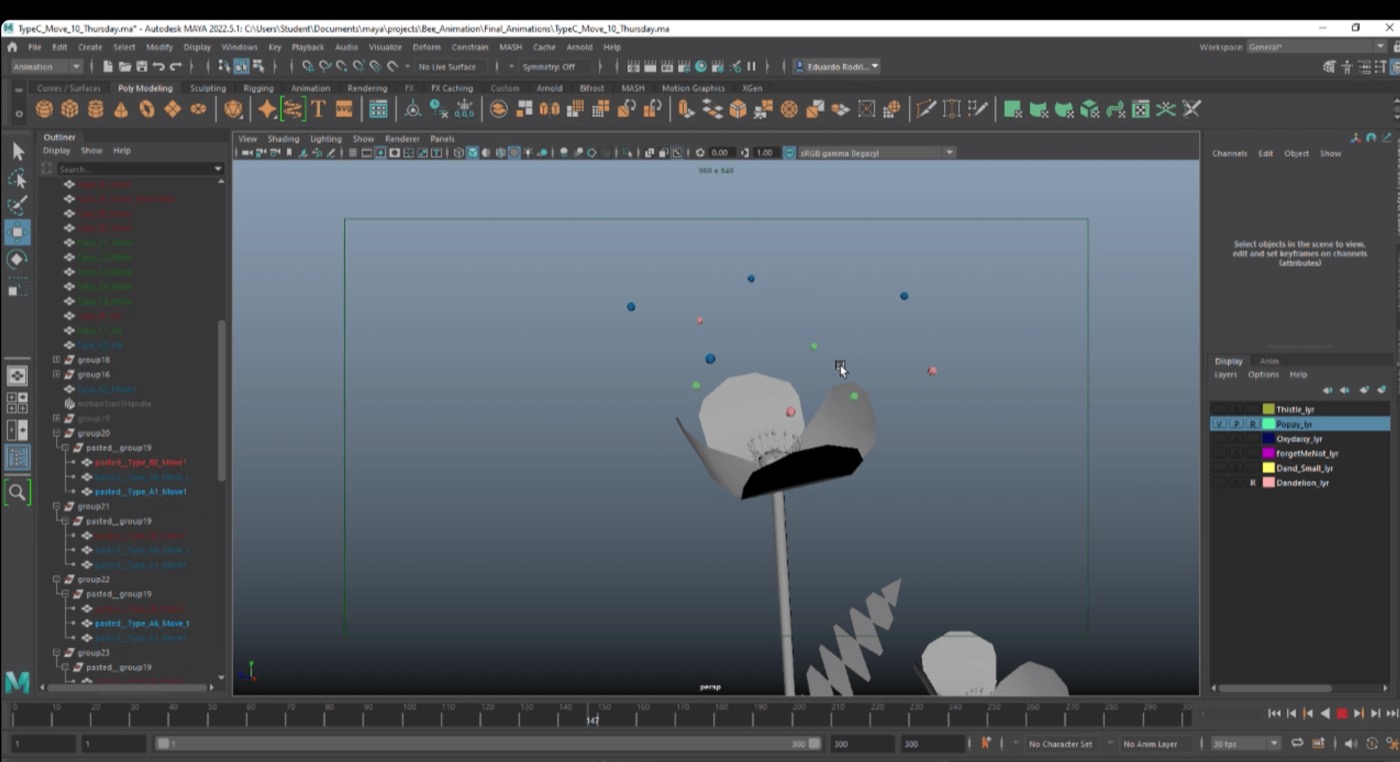
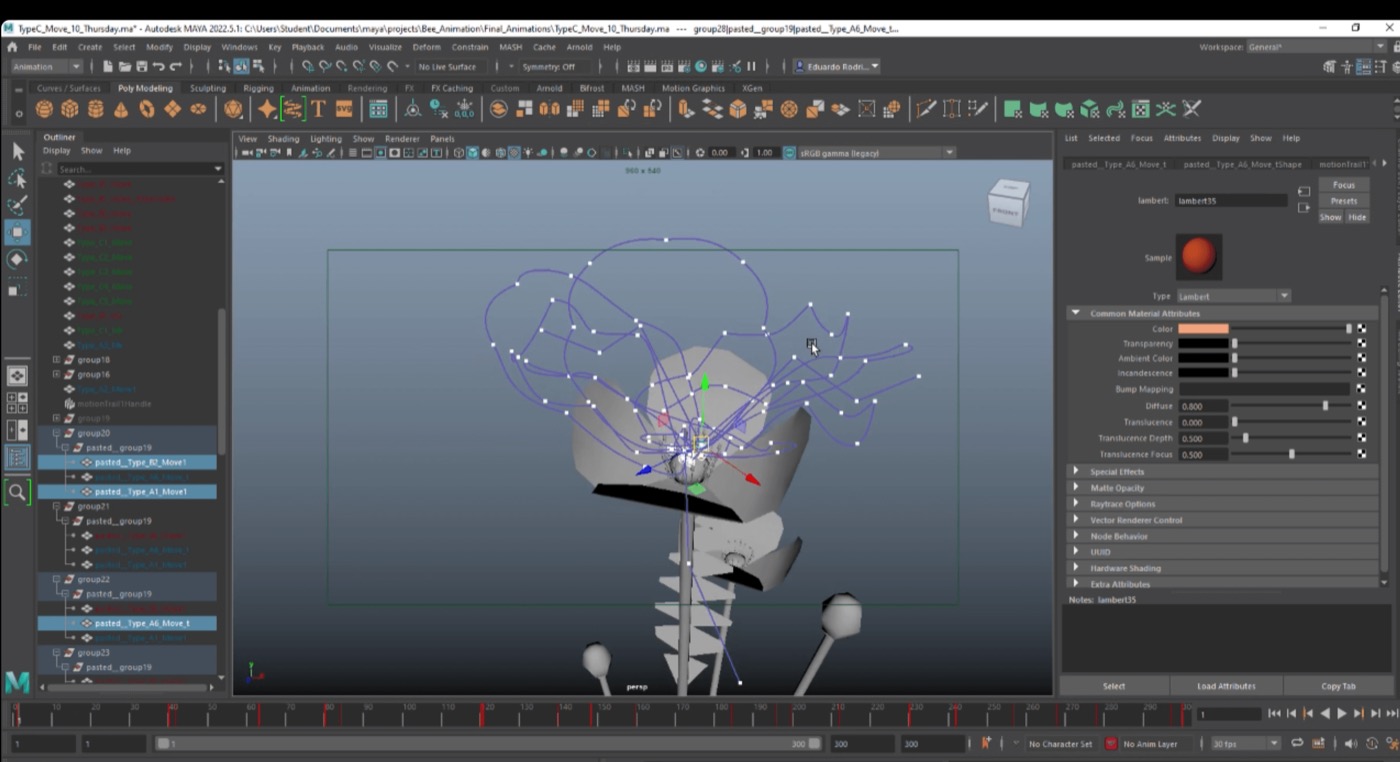
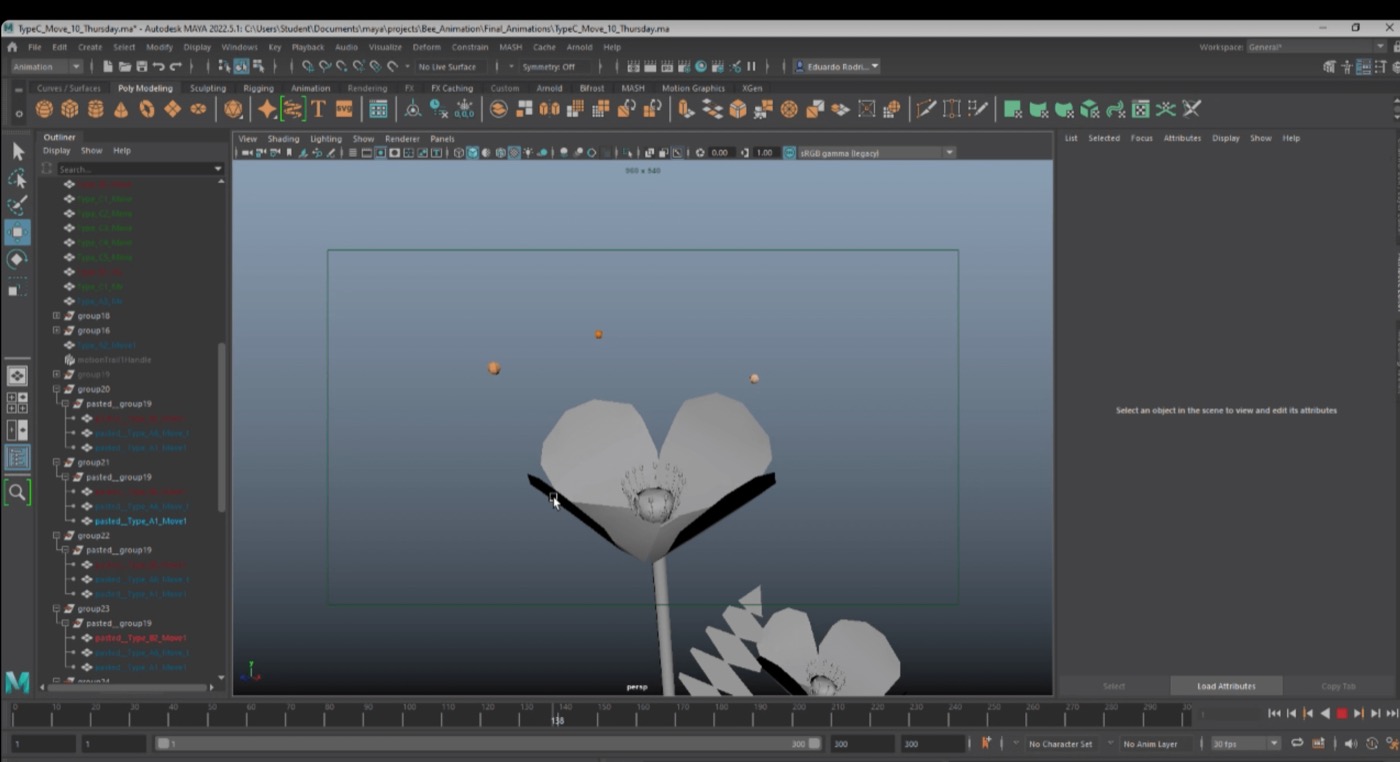
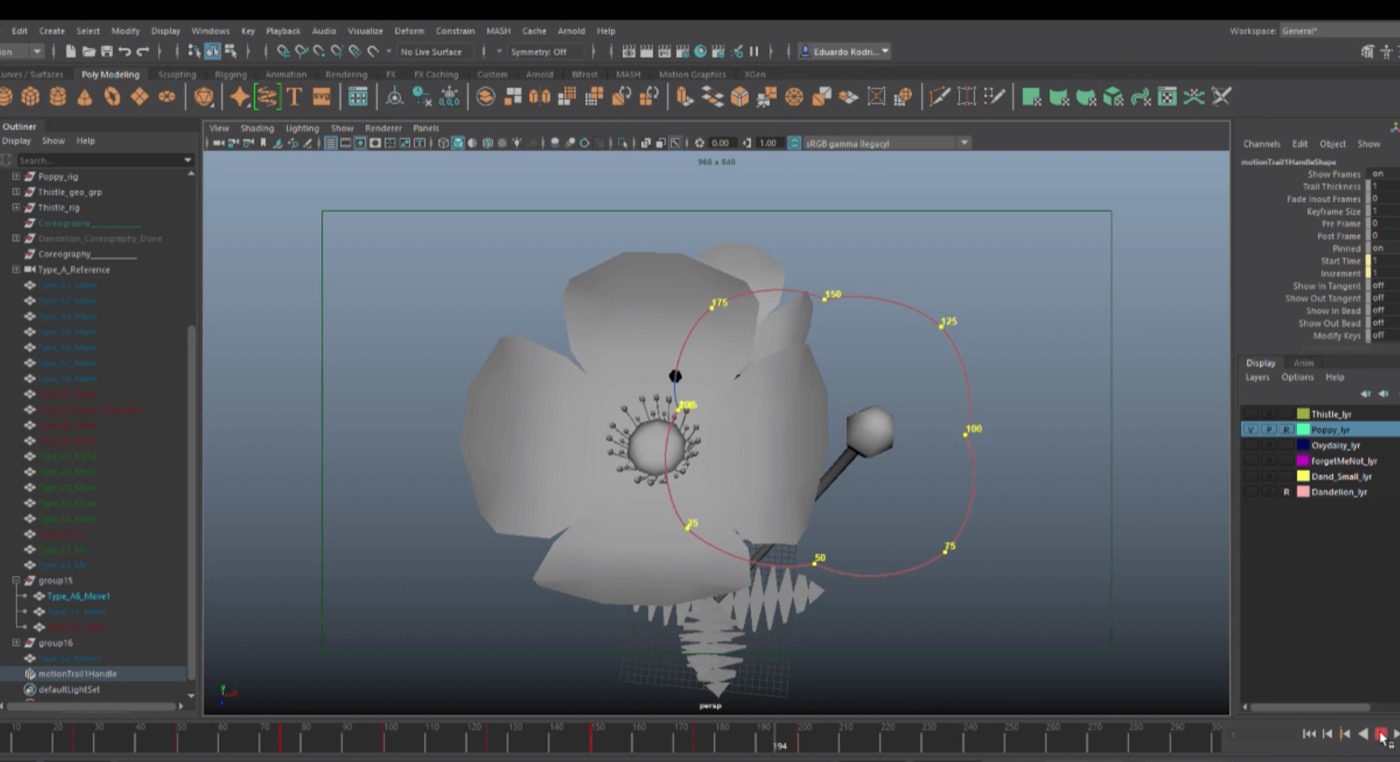
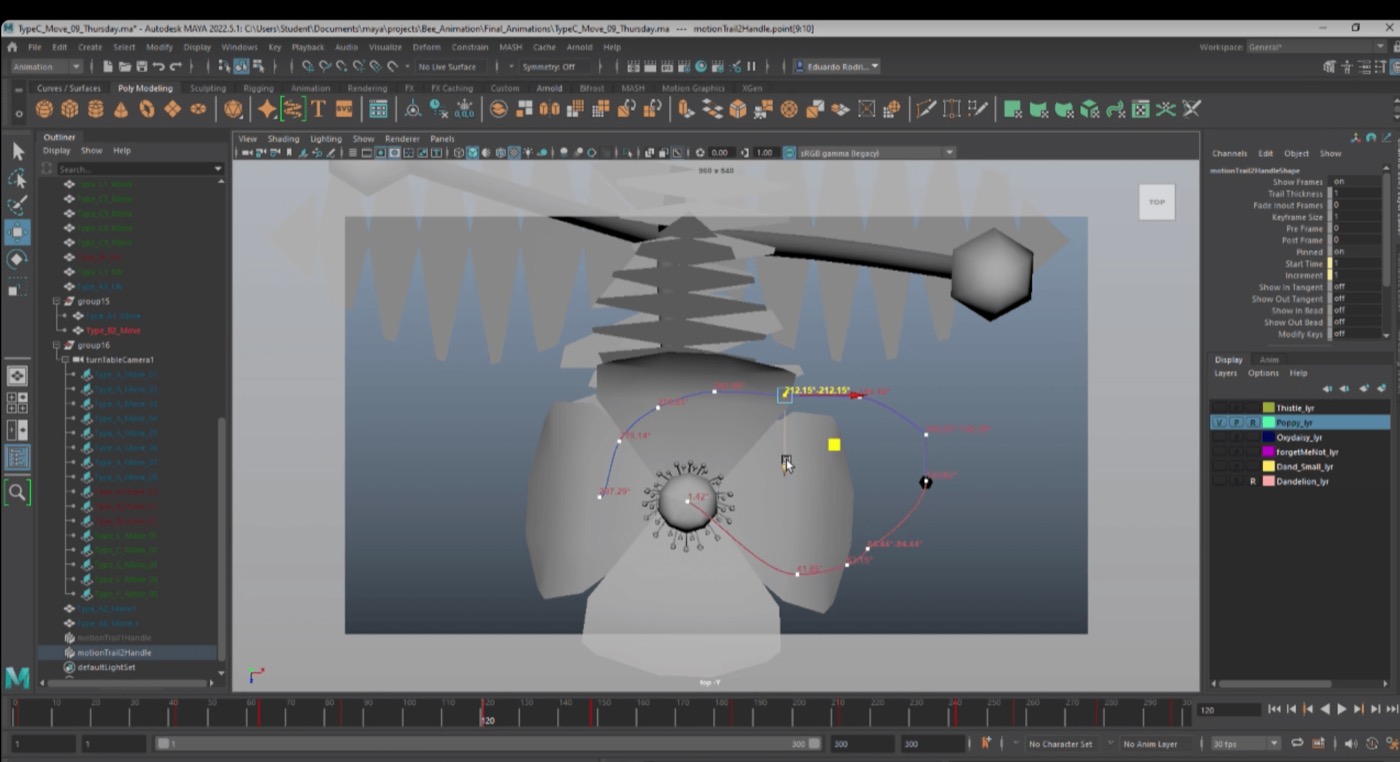
<p>We worked on three new trajectories for the poppy. We began with the forget-me-not, where Noora proposed grouping its nine flowers to create group movement rather than pollen always emerging from the centre, but time was short, so we moved to the poppy. Choreographies A1, A6 and B2 were chosen.</p>

<p><img src="/img/bees/05.jpg" alt="First poppy trajectory in Maya" />
<em>First poppy trajectory (10 seconds).</em></p>

<p><img src="/img/bees/06.jpg" alt="Second poppy trajectory in Maya" />
<em>Second poppy trajectory.</em></p>

<p><img src="/img/bees/07.jpg" alt="Third poppy trajectory in progress in Maya" />
<em>Third poppy trajectory in progress. Reversing the original path wasn’t anticipated in rehearsal, so it was improvised in Maya following the line drawn over the dancer’s video.</em></p>

<h2 id="from-maya-to-unity">From Maya to Unity</h2>

<p>Much of the day went into the translation from Maya trajectories to Unity. Unity’s units affect the speed and scale of each trajectory, as do the original flower sizes and how they are scaled in the game, so these need to be synchronised before the pipeline work starts. Food for thought for next time; for the prototype it works.</p>

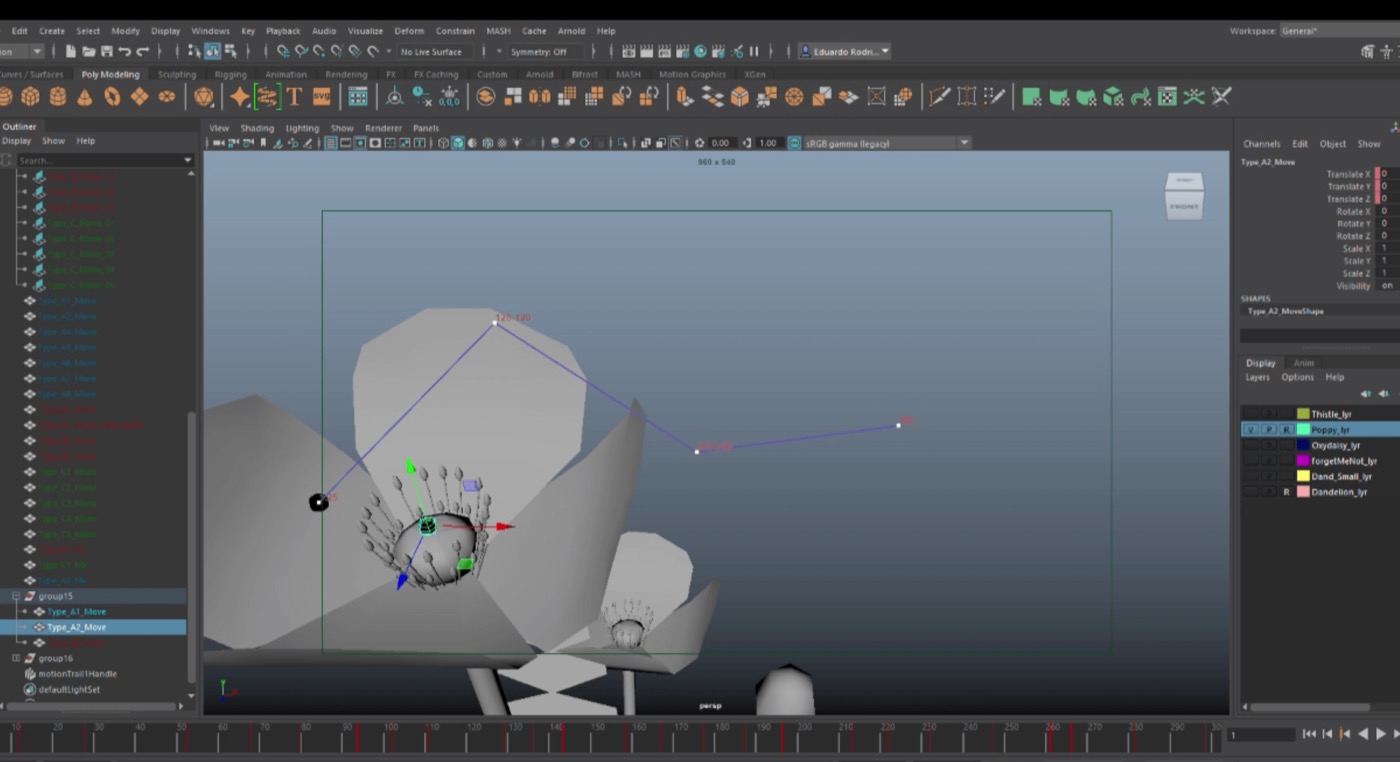
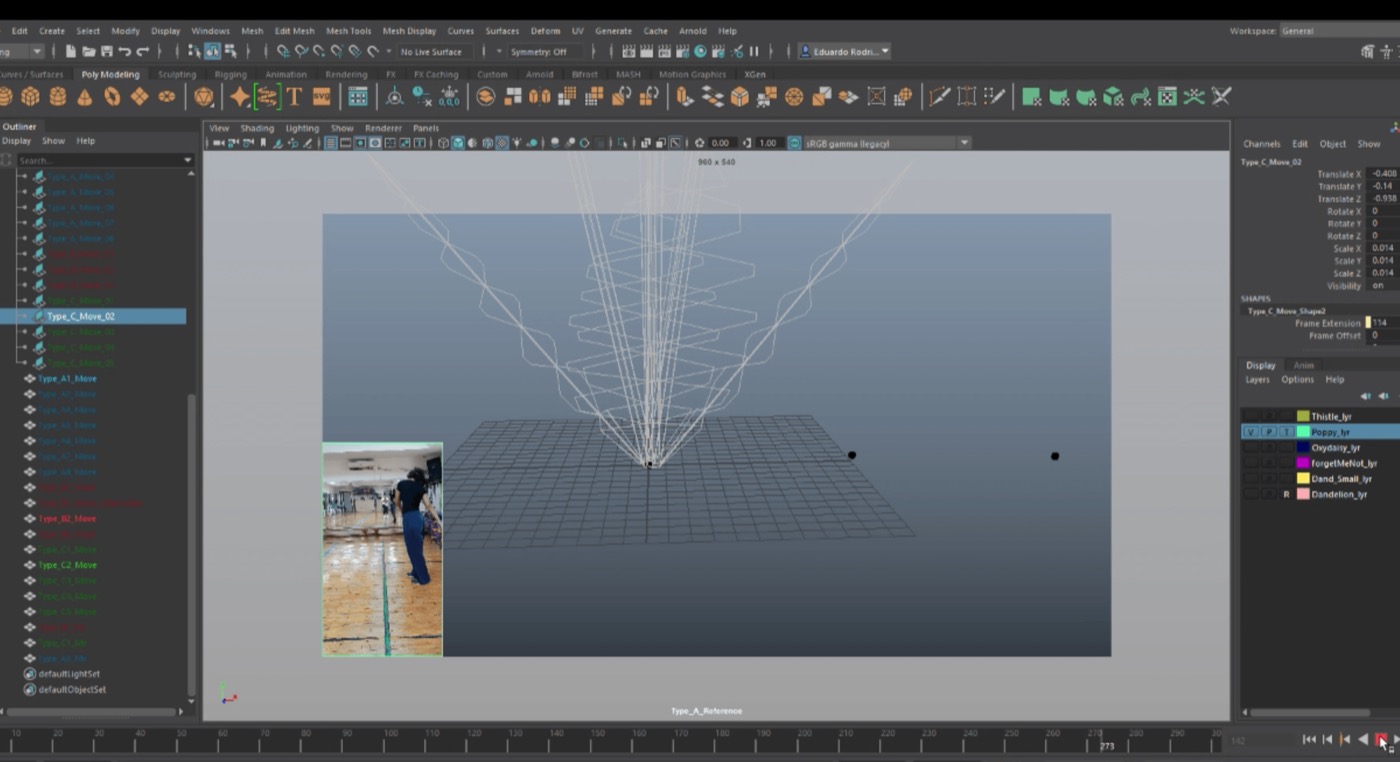
<p><img src="/img/bees/08.jpg" alt="Trajectory traced in Maya over a dancer video" />
<em>Eduardo tracing a trajectory in Maya from Noora’s videos, where the dancer is the pollen.</em></p>]]></content><author><name>Tommaso Perego</name></author><category term="Song of the Bees" /><summary type="html"><![CDATA[Discussion with Kush and Eduardo, then a meeting with Eduardo and Noora.]]></summary></entry><entry><title type="html">Building trajectories together</title><link href="https://www.soundandmovement.info/blog/2024/07/building-trajectories-together/" rel="alternate" type="text/html" title="Building trajectories together" /><published>2024-07-29T00:00:00+01:00</published><updated>2024-07-29T00:00:00+01:00</updated><id>https://www.soundandmovement.info/blog/2024/07/building-trajectories-together</id><content type="html" xml:base="https://www.soundandmovement.info/blog/2024/07/building-trajectories-together/"><![CDATA[<p>Meeting with Eduardo and Noora. Three choreography traces, each duplicated across 10 angles and seen from above, produced a striking, origami-like pattern: pollen types A3, B1 and C1, with correct height, speed and duration.</p>

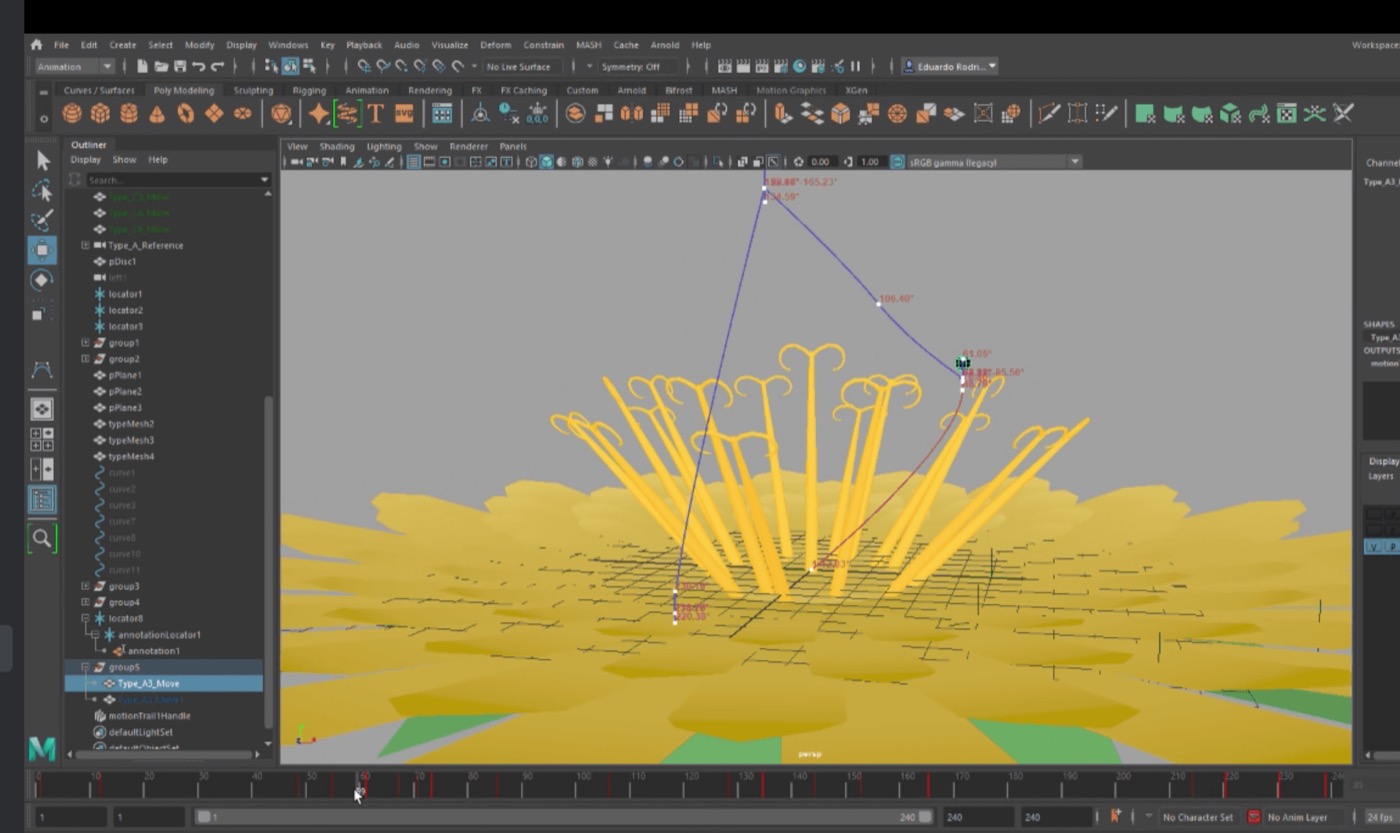
<p>Trajectories are a trade-off between the overall vision, Noora’s inspiration and Eduardo’s interpretation. After Noora’s work with the dancers, Eduardo could draft shapes from the demo videos, but things only unfolded organically when the two worked directly together.</p>

<p><img src="/img/bees/10.jpg" alt="Pollen trajectory in Maya" /></p>

<p><img src="/img/bees/11.jpg" alt="Pollen trajectory in Maya" /></p>

<p>The hard part was movement with vitality and character that is visible from the bee’s perspective, can be linked with sound, and moves at a speed that is perceivable and enjoyable.</p>]]></content><author><name>Tommaso Perego</name></author><category term="Song of the Bees" /><summary type="html"><![CDATA[Meeting with Eduardo and Noora. Three choreography traces, each duplicated across 10 angles and seen from above, produced a striking, origami-like pattern: pollen types A3, B1 and C1, with correct height, speed and duration.]]></summary></entry><entry><title type="html">Visibility from the bee’s point of view</title><link href="https://www.soundandmovement.info/blog/2024/07/visibility-from-the-bees-point-of-view/" rel="alternate" type="text/html" title="Visibility from the bee’s point of view" /><published>2024-07-28T00:00:00+01:00</published><updated>2024-07-28T00:00:00+01:00</updated><id>https://www.soundandmovement.info/blog/2024/07/visibility-from-the-bees-point-of-view</id><content type="html" xml:base="https://www.soundandmovement.info/blog/2024/07/visibility-from-the-bees-point-of-view/"><![CDATA[<p>Meeting with Kush and Noora to show the choreographed trajectories implemented for the dandelion.</p>

<p>Noora felt the pollen wasn’t visible enough: its path didn’t fill enough of the bee’s field of view, which hurt both gameplay and the enjoyment of the choreography.</p>

<p>We set an ideal height for the pollen, looked at movement type A3, and sketched how trajectories should scale in proportion to the flower.</p>]]></content><author><name>Tommaso Perego</name></author><category term="Song of the Bees" /><summary type="html"><![CDATA[Meeting with Kush and Noora to show the choreographed trajectories implemented for the dandelion.]]></summary></entry></feed>