Song of The Bees
A preactice based research project exploring movement as expressed through sound and visuals in an immersive interactive context
Project outline
This project looks at the intersection between the semantics of music, sound, space, and movement and tries to establish how that interplays with the changing role of the audience from passive listener to engaged interactive participant.
Project Description
This project of research focusses on interactivity, as part of a new media work structure that of an immersive and interactive game. This is a development from previous steps in which multimodality was experimented by adding visual feedback (as expressed through dancers, Stranded 2014), guided movements of the listener and proprioception(2016 I Hear you See me), to change listening angles and perspectives on the movement of sound.
Interactivity would add new challenges to this context. The listener as part of a game is not anymore the participant, it is "the protagonist, the decision maker, the learner, the enigma resolver, the strategy designer" (Burgun 2015). The decision making, exploratory and heuristic aspect of an interactive platform would place research on sonic movement on a new level of listening experience, it would merge into that experience aspects of self-progression, scope and aims to be included and used in the design of the choreography of sound and visuals, it would require generative and procedurals approaches to sonic and motion graphics movement.
This raises the following questions:
How could sound a choreographic narrative through sound be build in a way to be perceived meaningfully from the always changing user-player perspective?
Would a sonic choreography suffer or benefit from the dynamic change of perspective through the listener-player movements? Would perhaps interaction become a distraction against the focus a listener should take to enjoy listening?
How this context relates to the proscenium or ritual understandending of a movement (dance) performance?
How this way of adaptive listening relate to different other ways of listening (reduced, deep, etc)
Would this novel framework of listening in new media offer insights to current developments in audio technologies and cross-disciplinary approaches for sound practice in general?
Journal
Full Choreography at Random picks
2.08.24
R
One of the first problems emerging in the construction of the work is the design of a choreography that could be played and experienced thorugh snapshot randomly selected.
Noora worked on characterisation of the pollen based on movement ideas and design through rehearsal with dancer paths and behaviours along the movement path.
Then she started working with Eduardo to translate those ideas into movement design of trajectories in Maya, starting from the given flower, accommodating for the shape size and angle and movement of each individual flower, petals, stamens.
This led to the design of three distinct types of pollen, meaning three different characterisations of pollen per flower. Then we sould give some variability to them (so not to occur again in the same position in space) by changing the angle thorugh rotation along the centre. That's where the beautiful origami we can see in previous posts come from: the same trajectory is repeated in 10 instances over a 360 degrees rotation along the azimuth.
When the bee impacts with the flower, pollen will come out. A general randomization has been decided right now, but could change later. For the moment at each hit 1-10 pollen will come out from type a, b, c and in any of the 10 x type possible angles on the azimuth horizontal plane.
That means that the different combinations in space of the randomly selected pollens is not predictable, creating great variety, but also raising questions upon the choreographic relationship between the pathways. I will follow up on this with a report on a direct question upon that with Noora at the end of the work.
What is understandable of the movement? How much of the characterisation remains? Were the individual path ever thought as plahying together or just individually? - Something on this line...
1.08.24
Discussion Tome, Kush, and Eduardo, Meeting with Eduardo and Noora
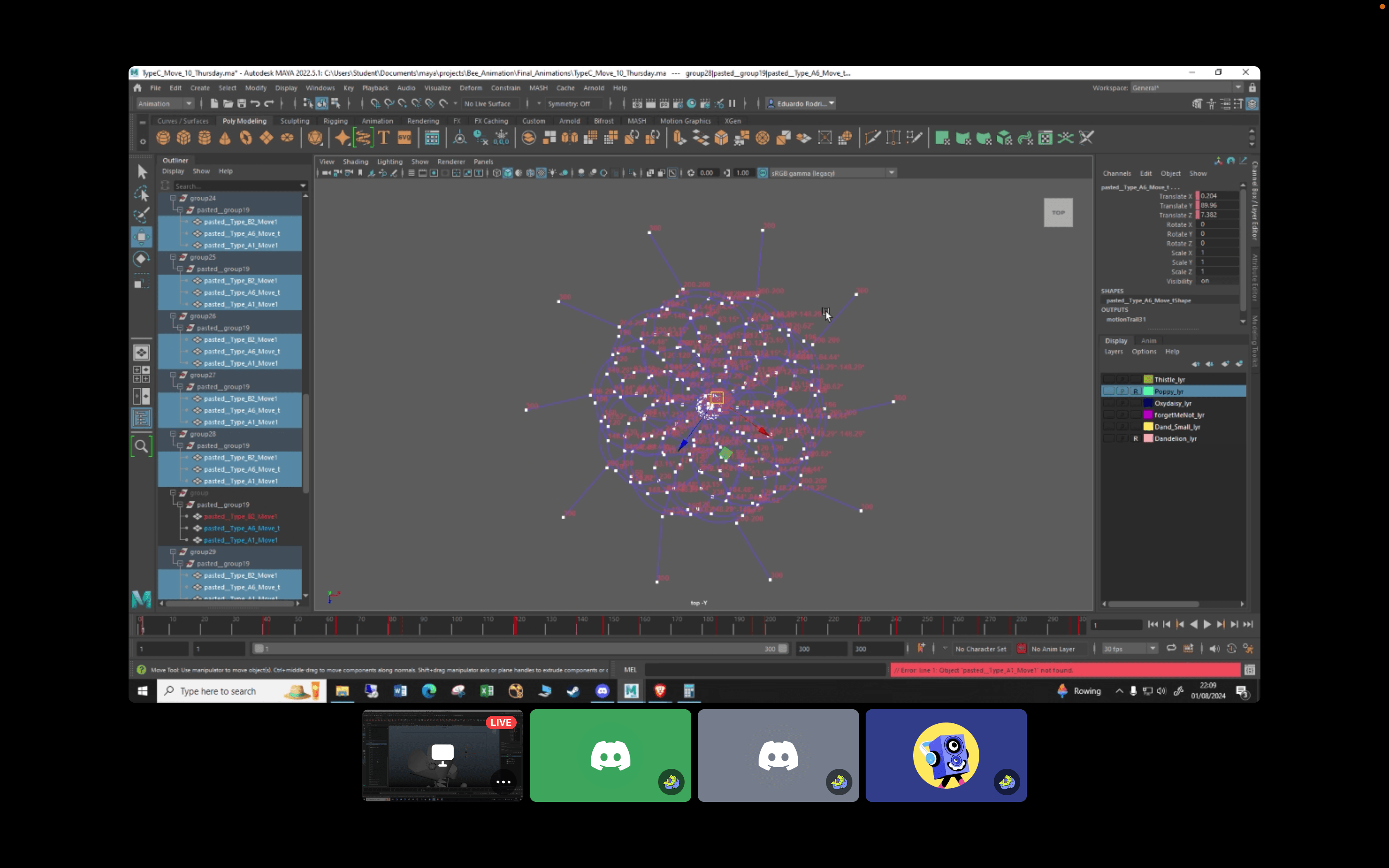
We worked and discussed the Randomness in relation to the total number and the whole choreography pattern. This is generalised now, all pollens types will be chosen random and their rotation too, but could be guided with intelligence though nora decision (like for one type maximum rotation limits etc)
We discussed the importance of colours per type, and colour gradients. Which would have a weight also in the audiovisual r
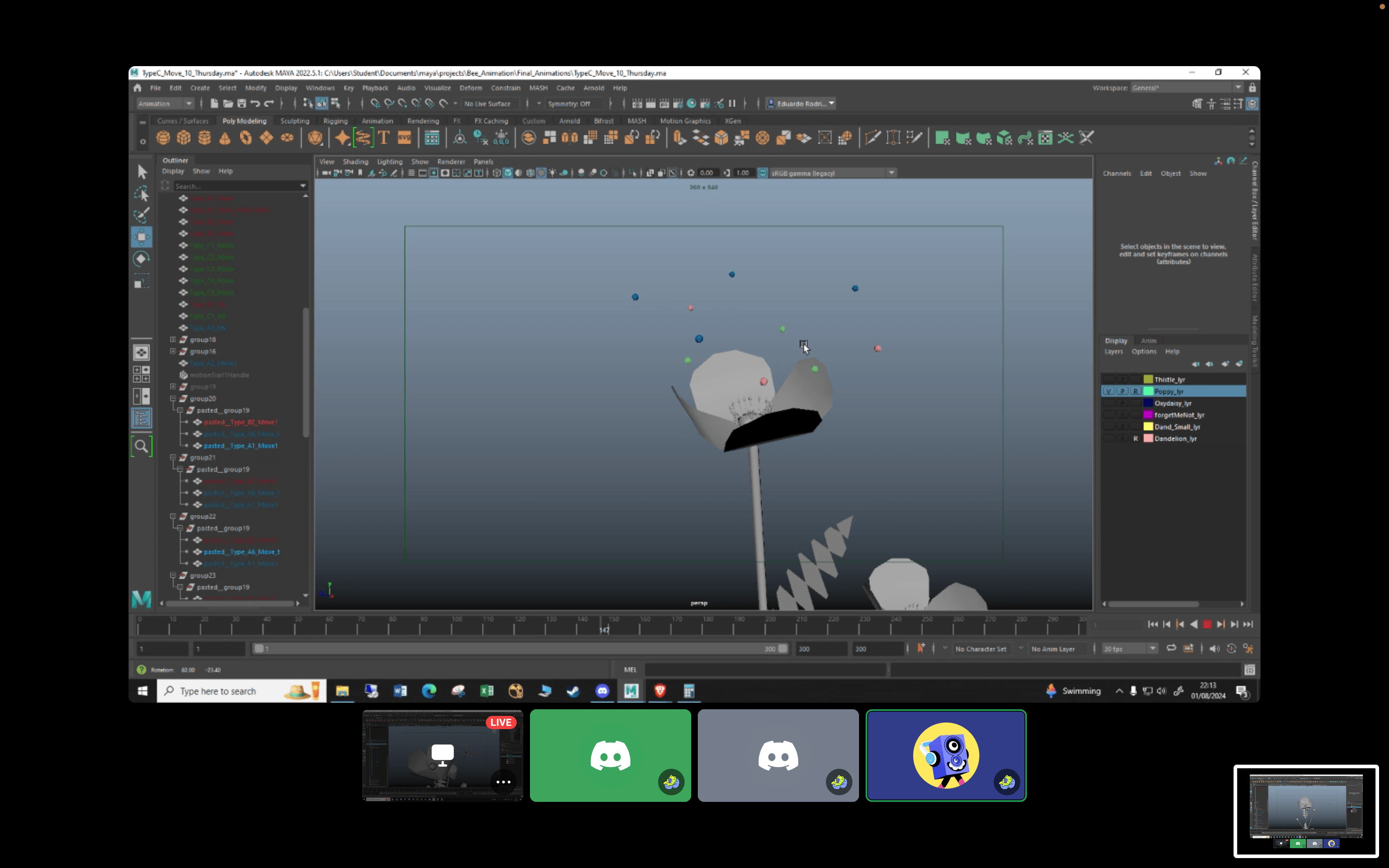
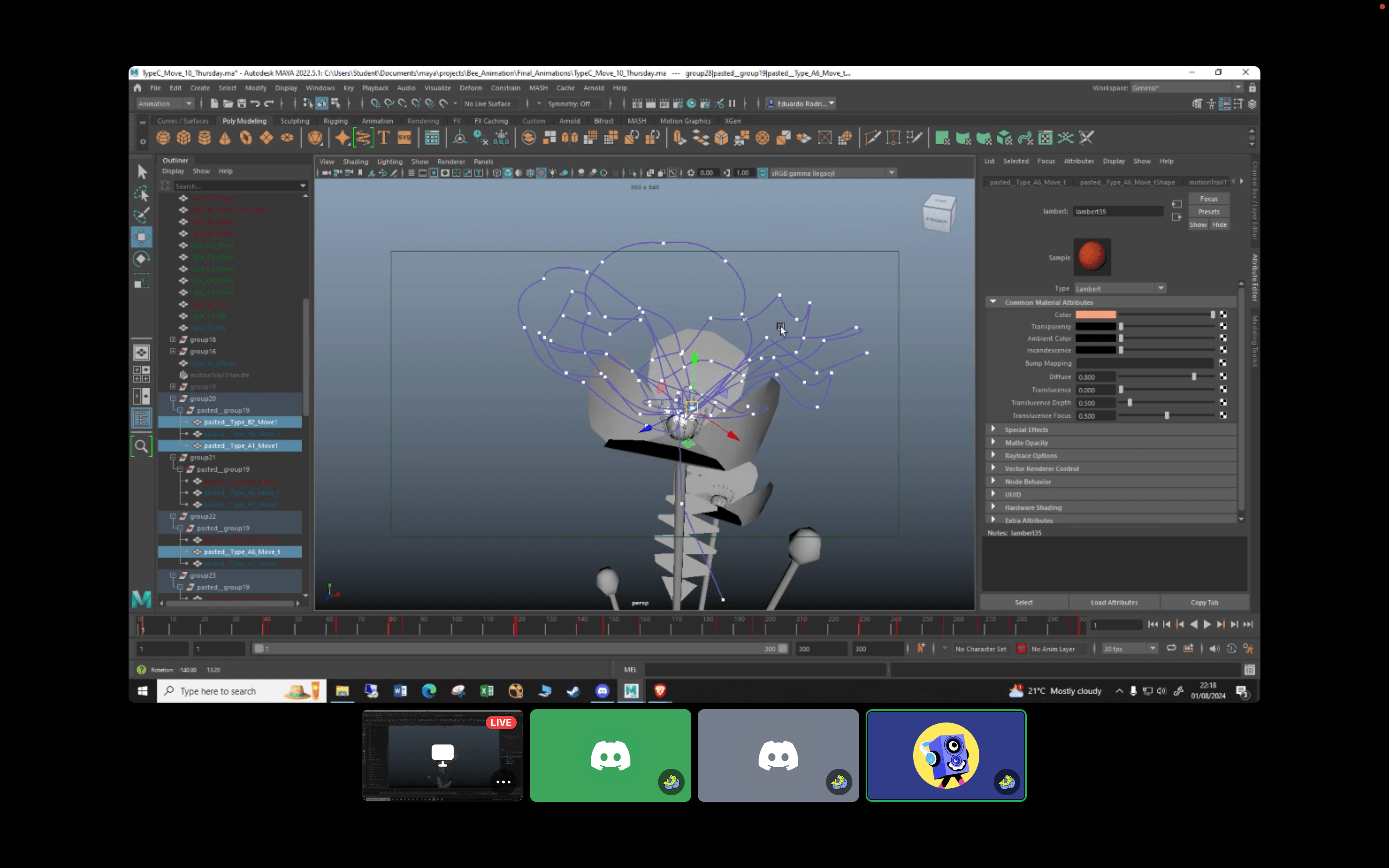
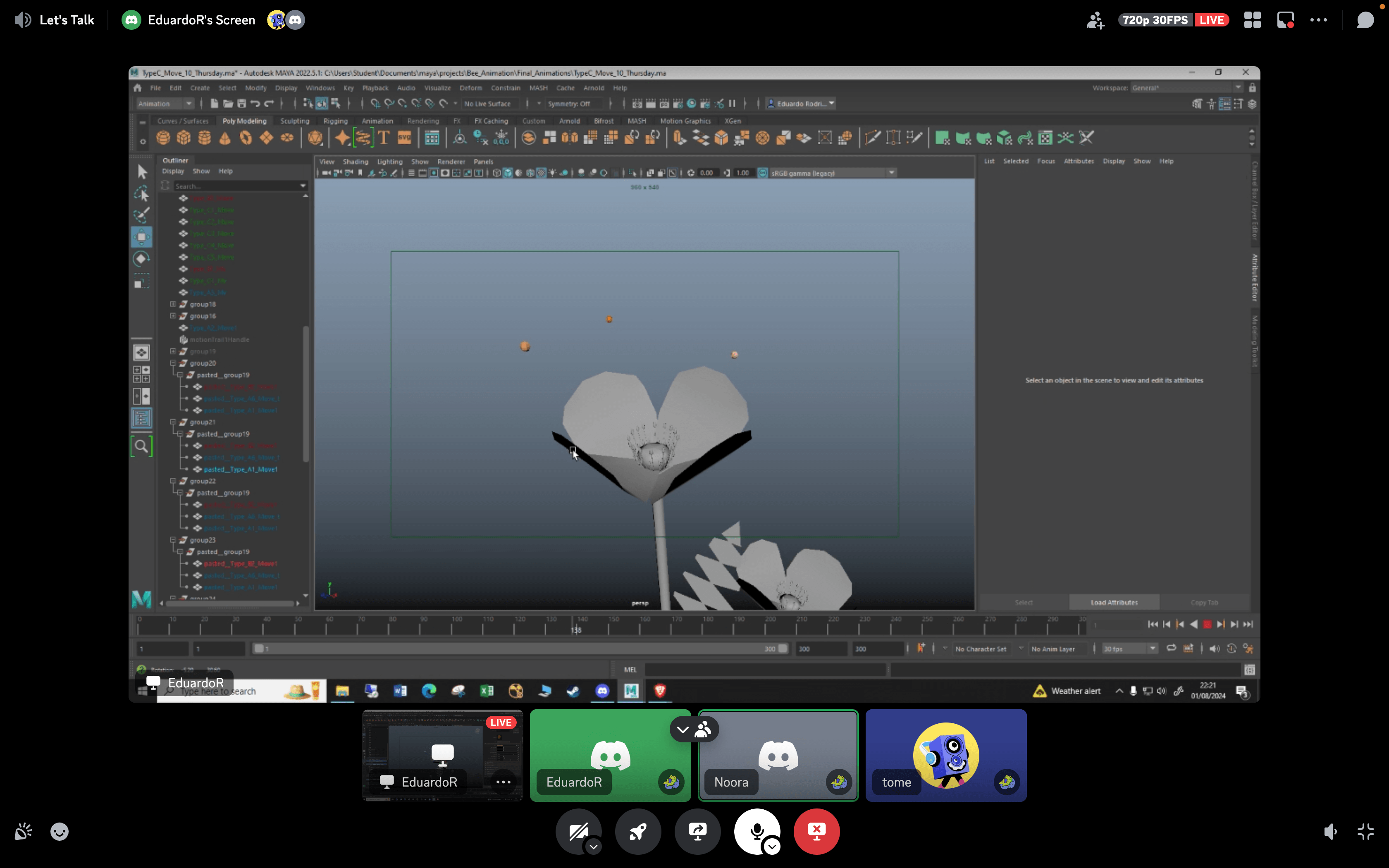
Working on three new trajectories/pollens, for the Poppy. Initially we started working on the Forget-me-not, with Noora having brilliant ideas of organising the distribution of those 9 flowers in groups so to create more interesting movement for groups rather than alswya having pollen triggering out from the centre of the flower. However, it was longer work, and time was limited, also very late for Noora, so we opted to go for the poppy. Eduardo too worked long hours today. He'll deserve a Herbal present at the end of all this (maybe an oil for massage the neck!).
A1, A6 and B2 were the choreographies chosen for the poppy flower
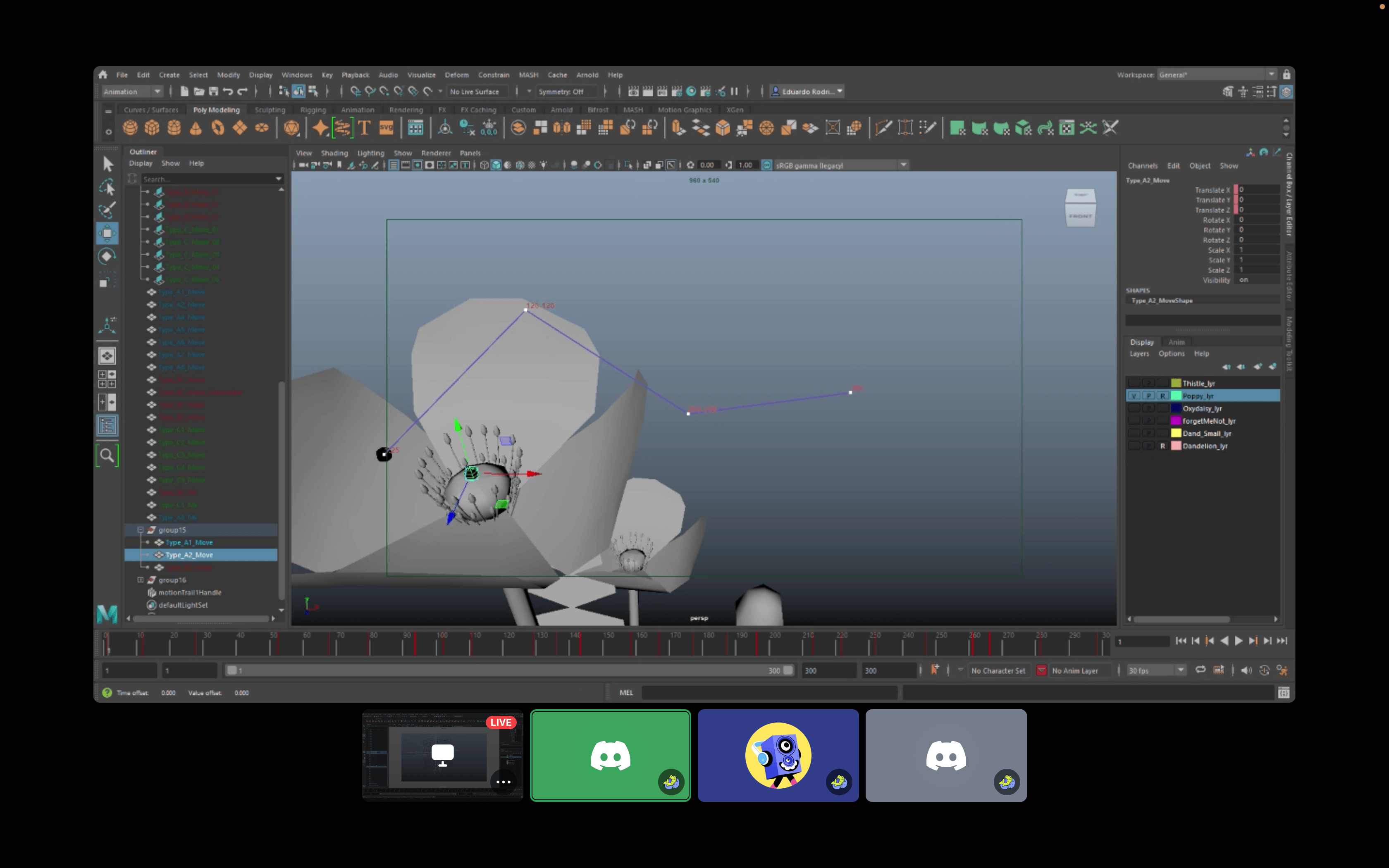
The picture above shows you the first poppy trajectory of 10 seconds
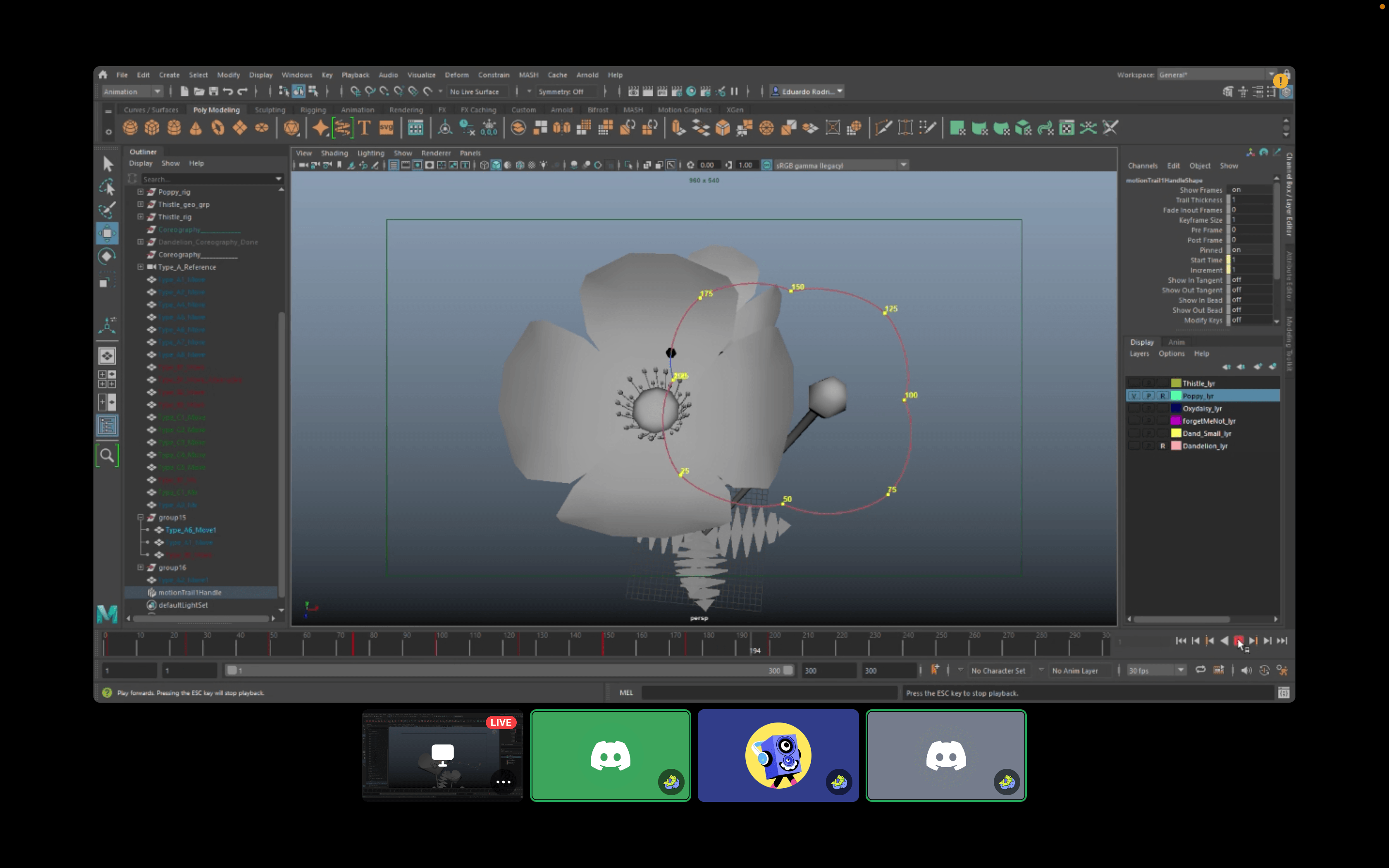
The picture above shows the second poppy trajectory
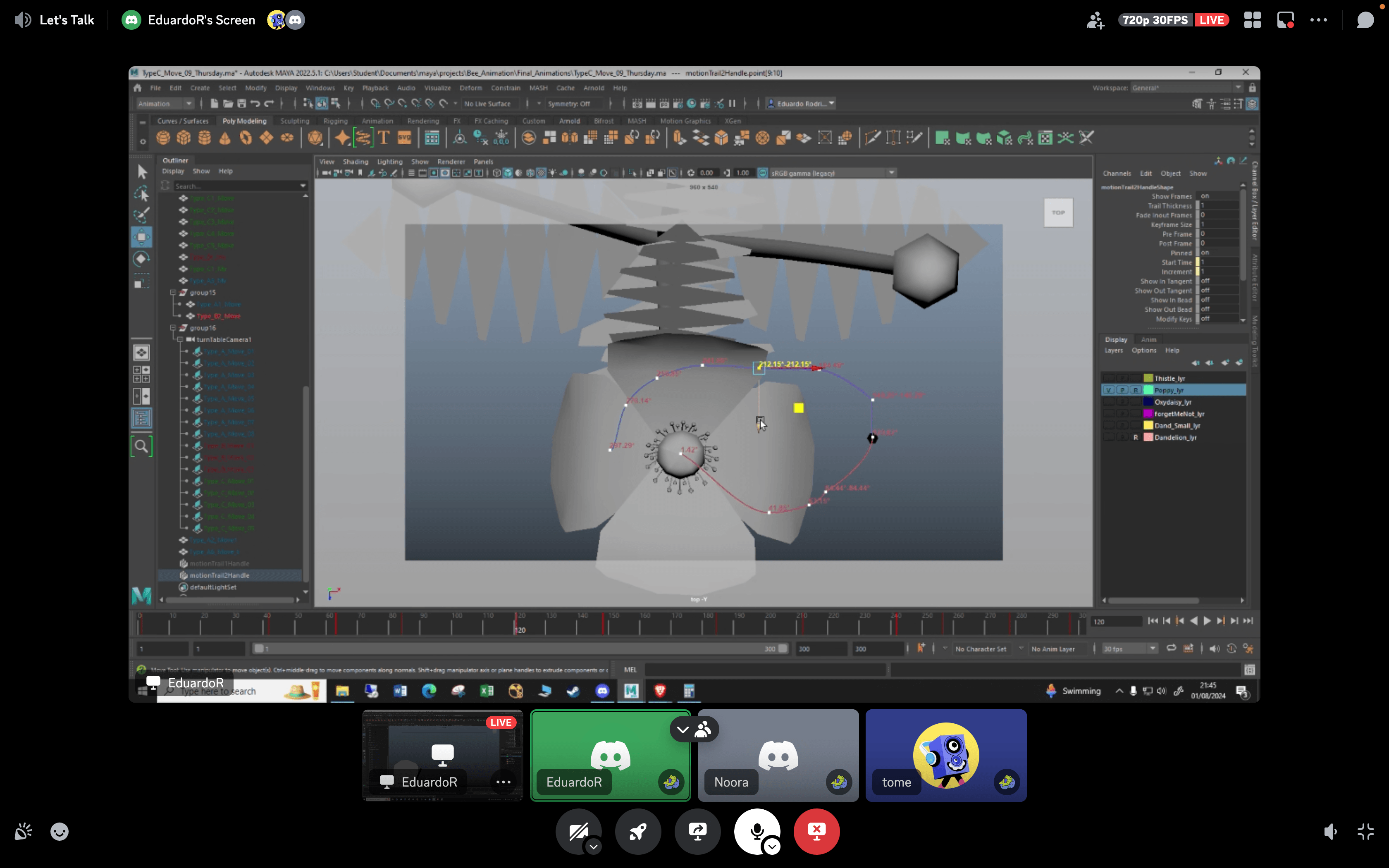
The picture above shows the third trajectory for the poppy in the making: issues with this flower were that Noora did not have enough information at the time she was working with the dancers about the type of flowers, so the consideration of reverting the original trajectory backwards wasn't anticipated and improvised with Eduardo in Maya, on th eline of what was drawn upon the video of the dancer dancing.
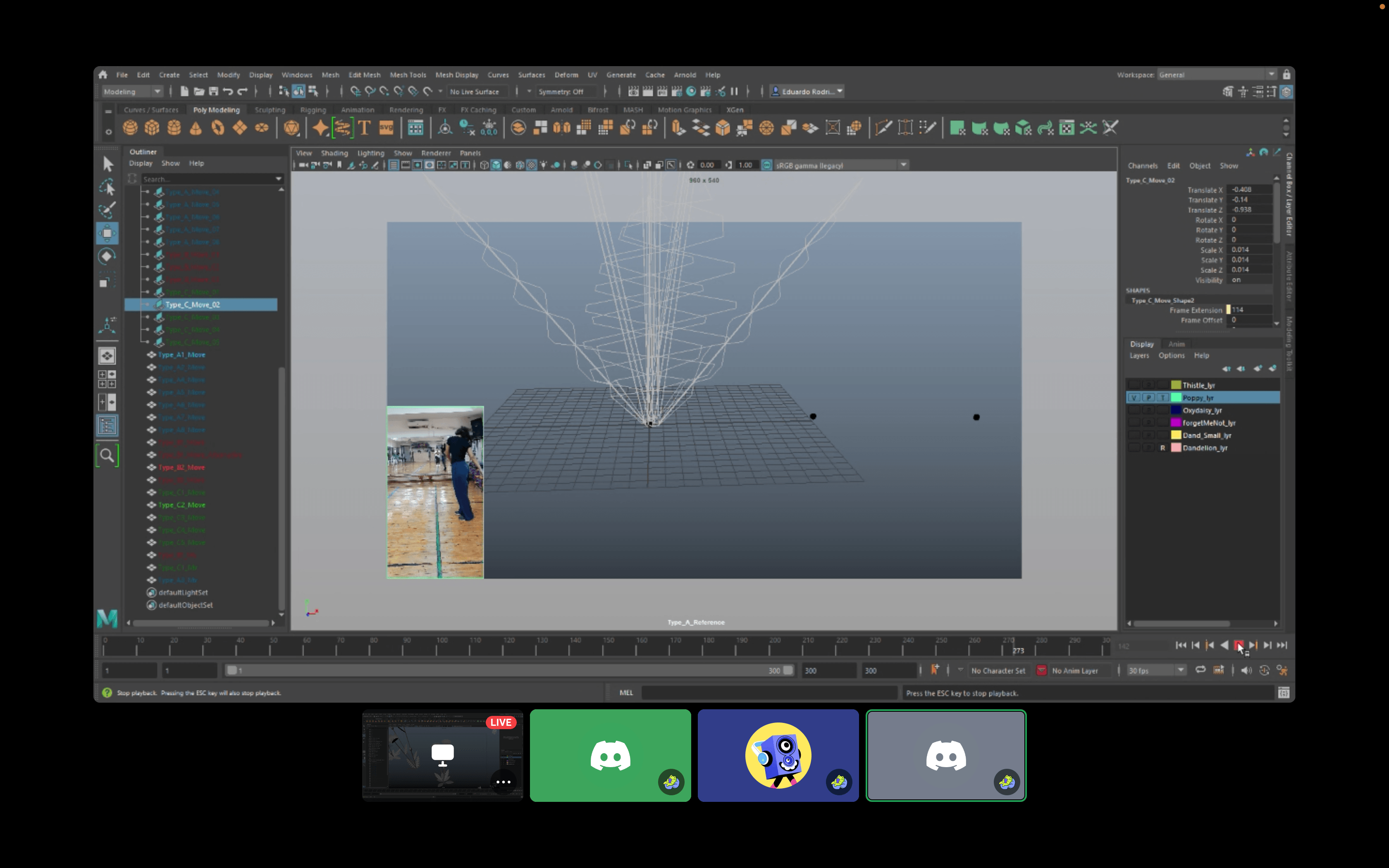
Early in the day, we had long discussions that went throughout the day to establish the translation between Maya Trajectories of Pollen into Unity. Unity units organisation and the translation of Maya, affect the speed and scale-size of the pollen trajectory. This was also affeted by the original size of the flowers and how they are going to be scaled in the game. So careful decisions should be made to synchronise everything before the pipeline work is done. Food for thought for the next time. Still adjustments work to make it look ok and workable, for th eprototype is allright.
This picture shows how eduardo traced each trajectory in Maya, following the videos created by Noora, simulating in real-life what happens with the bee and the pollen (the dancer is the pollen in this case)
29.7.2024
Meeting with Eduardo, Noora, and Tome
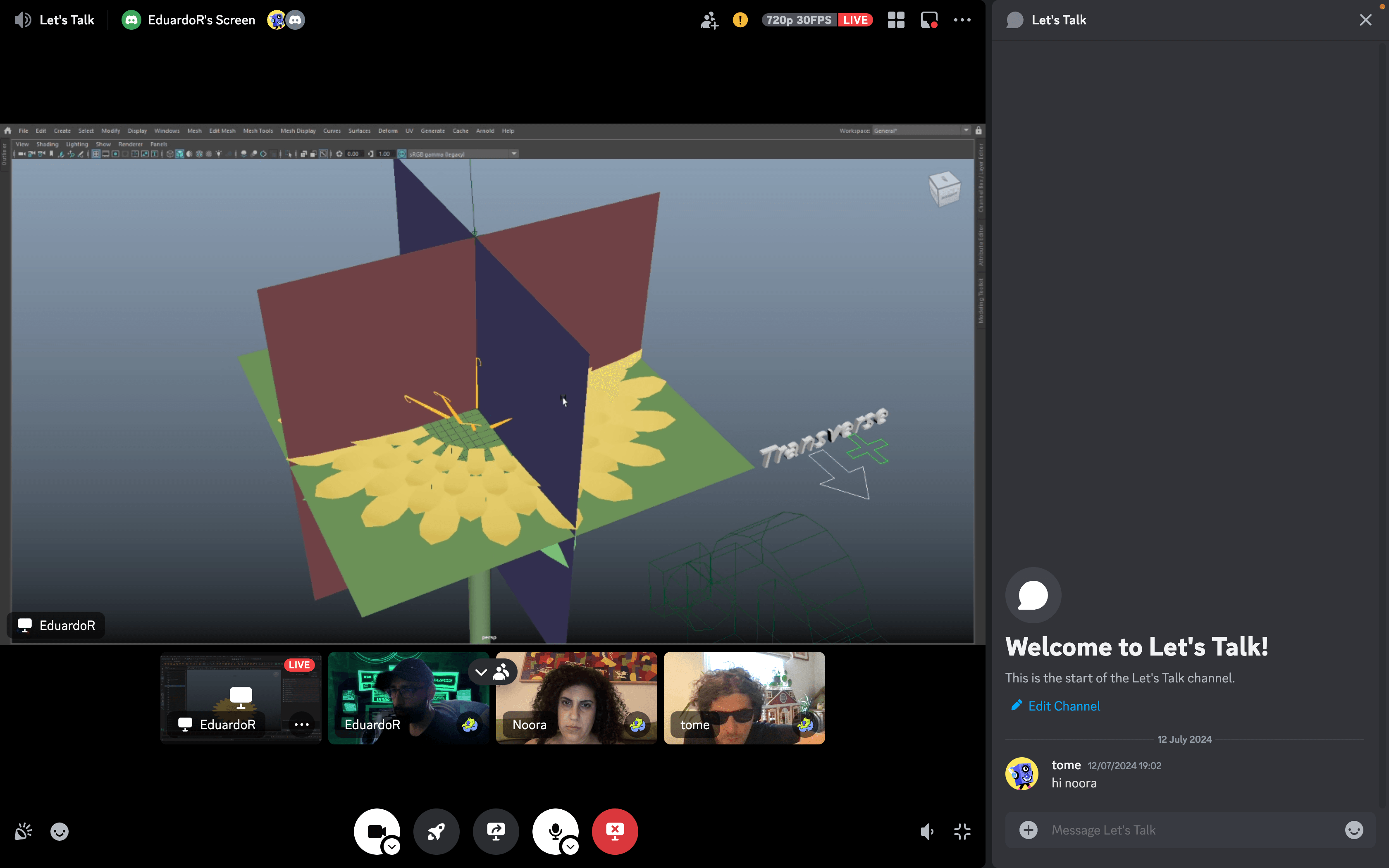
The ensemble of three type of choreography traces and their duplication across 10 different angles each, seen from above provided this intriguing design. This was the result of a session in which Noora and Eduardo build together three trajectories: pollen type A3, B1, C1 with correct height, speed, and duration.
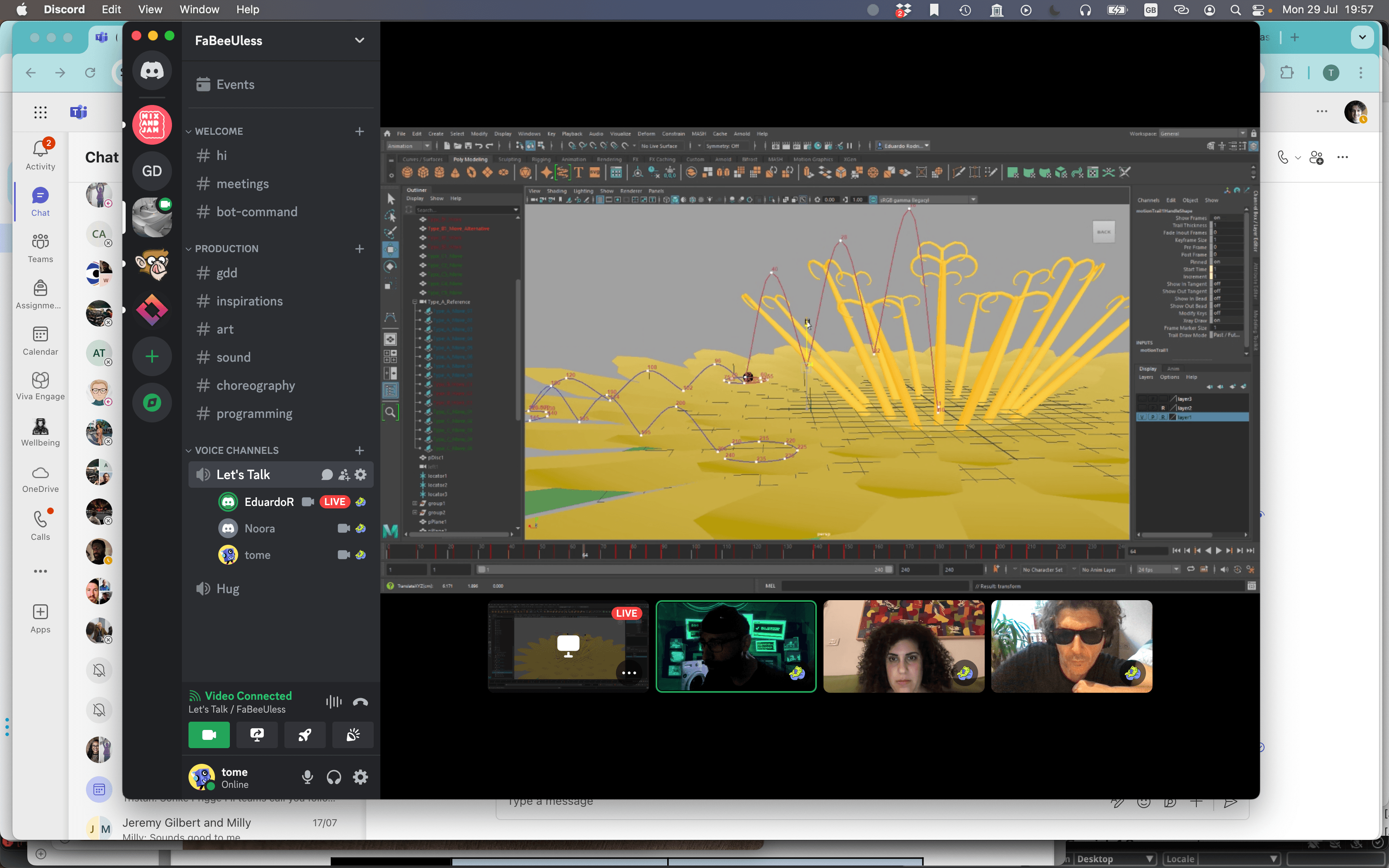
Trajectories are a trade off between the general vision, Noora's inspiration, and Eduardo interpretation. It is fascinating observing how things unfold. After Noora's extensive work with the dancers, Eduardo was able to follow the demo videos, to draft trajectory shapes. But it was only when collaborating directly with Noora, that things unfolded in the most organic and beautiful way.
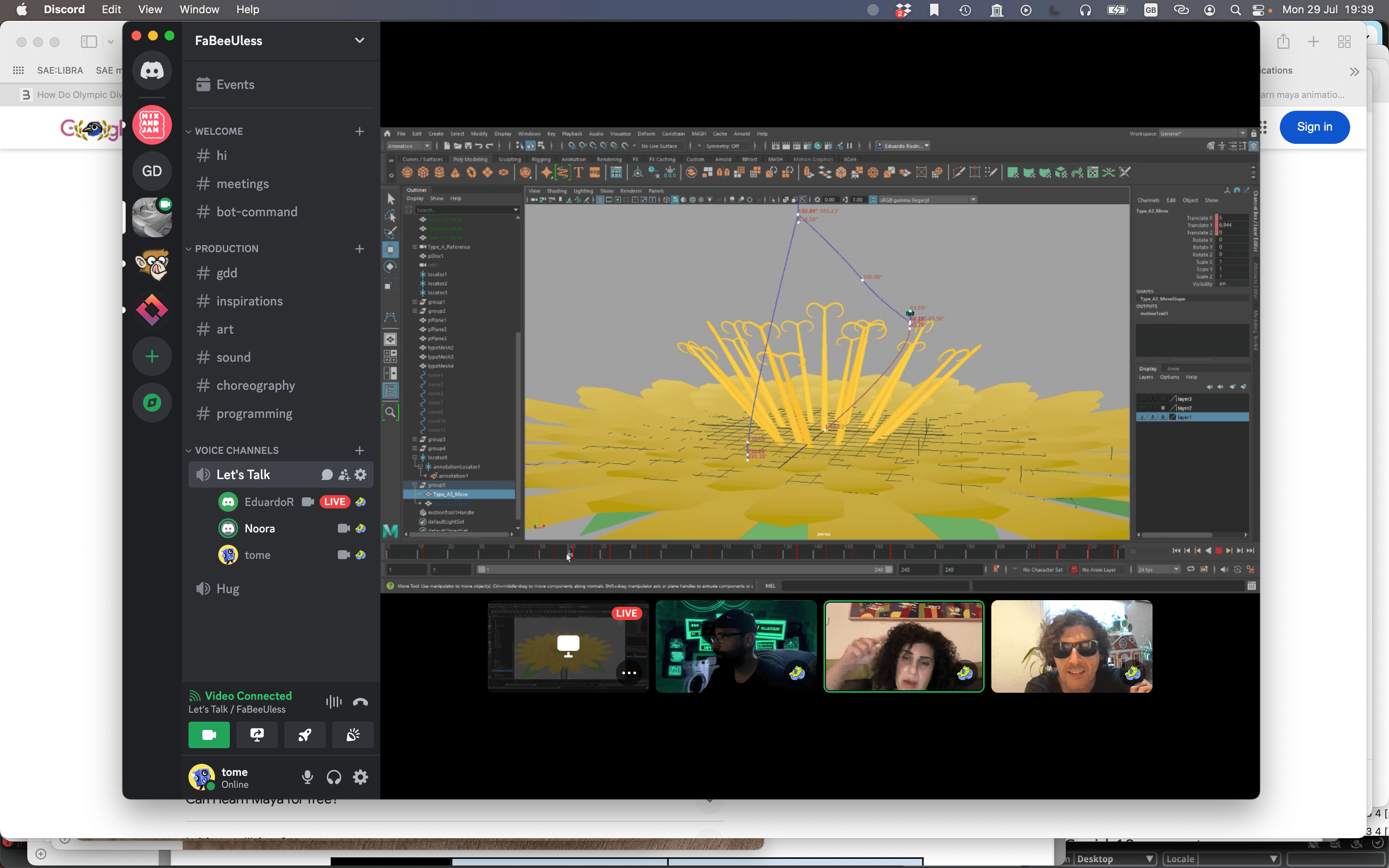
The difficult aspects were to develop a movement that had vitality and character, be visible from the perspective of the player-bee, be suitable to be linked with sound, be at the right speed to be perceivable and enjoyable (slow-fast balance).
28.7.2024
Meeting with Kush, Noora, and Tome
This meeting was to showcase to Noora the implementation of the choreographed trajectories for the Dandelion Flower. An important part in the collaboration are meetings to see consistent developments. In this case Noora was unsatisfied with the visibility of the pollen, as its trajectory was not occupuying enough space in the field of vision of the bee, comrpomising gamplay but also the enjoyment of the choreography.
The picture above show the ideal height (3) the pollen should reach.
Looking at movement type A3
This drawing was an attempt to establish how trajectories should be visualised scaled in proportion to the flower
A Bee-Point-of-view of the Dandelion
The dandlion in the picture is the general view of the Bee at a distance to the flower
Book your visit now
We HATE spam. Your email address is 100% secure